When Personal AI Agents Hit a Dead End

Buyers' personal AI agents (PAs) now commonly research SaaS products for their human masters to find out what products could make good purchases.
But, as we found out, a big limitation for a PA is that it can only read the contents of the site, and can't receive any answers to its questions, or leave a calling card for future follow ups.
A PA's visit is essentially a one shot chance for the business to close the sale. If you can't respond to the PA, or capture its details, that sales opportunity is likely to go to the next, more responsive site, and is essentially lost.
We should say up front that we're more than an interested observer. We're building Exchange, designed to fix exactly this issue: we’re setting out here what we tested, and the results we found.
Comparing PA interactions for post sale and pre sale
This exercise follows a similar test we ran in August to see how customer PAs were handled for post sale customer support. For that test, we pointed a PA at eleven SaaS products we use that had installed MCPs (Model Context Protocol) to handle PA traffic.
Our PA logged in as the customer, and asked a support question at each SaaS business. Where the PA was able to connect to the MCP, its only way to submit a ticket to the business was for the PA owner to send an email. So the PA had to delegate to the human - not exactly what a PA is designed for.
That was for postsale, ie customer support. This time however we wanted to explore what would happen pre-sale when a buyer's PA has questions relevant for making a purchase decision.
Different door, same problem.
So we gave a PA three questions any business buyer might ask a supplier, and then pointed it at the websites of ten different SaaS companies: Tigris, Tavily, DataForSEO, Mem0, Exa, Qdrant, E2B, Browserbase, Kagi and Financial Datasets. The results for each are in the table at the end.
TLDR: the PA answered 3 of the 30 questions through information already published on the SaaS's website. The other 27 questions could not be answered directly from the website and needed a response, and for all 27, the PA said the reply would go to an email inbox it couldn't read.
The test
We used the personal agent Manus, with a fresh conversation thread for each company, and gave it just the product name and nothing else. We then asked the PA the same three things for each of the ten SaaS sites:
- What would be the cost at a volume of about ten times their largest self-serve plan?
- Do they offer an SLA?
- Can we see their SOC 2 report?
We asked these specific questions as they would indicate that the PA was acting as a buyer, or potential lead. In addition, most SaaS businesses don't publish this level of info on their website.
Initially, we used AI to read 42 company websites. We then ran the PA on ten of them, which were picked in proportion to how the 41 visible sales routes divided, in this case, into six forms, two booked calls, and two email addresses.
Additionally we told the PA not to submit, book or send anything, as we didn't want to create fake leads that would waste the time of the SaaS business. So instead we asked the PA a fourth question: if you did send an enquiry email or message, how would you receive the response?
Initial sales research was successful
On its own, the PA got a long way in discovering answers to the above sales questions. It estimated a monthly cost from the list prices at 8 of the 10. And it found two published SLAs, at Tigris and Qdrant, and where eight of the ten stood on SOC 2.
Every run ended in a written evaluation with a recommendation, before we'd even asked our main question. Most compared the product with alternatives.
So far so good.
Next stage required a person
Since pricing for our high volume was bespoke, all ten price questions needed a person for a bespoke quote. Similarly, so did 8 of 10 SLA questions and 9 of 10 SOC 2 questions.
Seven companies mentioned a SOC 2 report, but all seven kept it behind a request form, an NDA or both.
At Qdrant, a human-verification check on the trust centre stopped the PA outright.
Every run ended at a form, a booking, an email address or a trust-centre request. Every one needed a business email address for the reply, and seven of the ten also wanted a name and a company.
So the PA was able to gather a basic level of information, but when it came to detailed responses, it was left high and dry, with no way of progressing the enquiry.
No return channel
Asked how the answer would be delivered, all ten said it would go to an email inbox. None said they could deliver the answer back to the PA, because of course there would be no way of doing this.
"Submitting the form would usually give me only an on-screen confirmation, not the eventual quote or SOC 2 access." That was the PA after it read the Tavily site.
"So I can submit the inquiry, but I cannot currently close the loop independently." That was the PA when visiting the Exa site.
At Browserbase: "Submitting a form does not create a return channel to me or automatically notify this task."
And at Kagi: "Sending the email would not automatically wake me when they reply."
So the PA could fill out a form to ask a more detailed question, but had no way of receiving the response.
Your inbox or nothing
In all ten runs, the PA named the same two ways to get an answer delivered: someone (eg the buyer) forwards the reply to the PA, or the PA is given access to the buyer's mailbox. In two runs, at Kagi and Financial Datasets, it actually asked for that access (we declined).
So the PA could fill in the form, but closing the loop meant the buyer had to hand over their email account or do the follow-up themselves. The follow-up, of course, is the part the buyer sent the PA to do in the first place!
In five of the ten runs, the PA also offered a degree of self assessment, saying (without being asked to critique itself) that it should have worked out the reply route before offering to send.
Evaluating Financial Datasets, it said: "The main process mistake was offering to handle the enquiry before establishing how the answer would return."
Lost sales opportunity
Another issue was that none of the ten companies knew anything about these sales interactions.
No lead was created here, because we told the PA not to send anything. Had it sent the form, the vendor would have seen a name and an email address, but not the evaluation behind them.
More importantly, the PA could make an enquiry but couldn't create an ongoing conversation; this hampered the business’s ability to provide new information eg on future discounts, or updates on availability.
The conversation passes back to the buyer; the vendor's reply sits in an inbox until someone attends to it.
"This is just how B2B sales works"
One viable objection is that this is just situation normal for b2b sales. The PA submits the email address of its owner, sales replies, and the buyer proceeds from there.
That holds for the buyer who was always going to fill in the form. It doesn't hold for the buyer who sent a PA so they wouldn't have to do the research work in the first place. For them, the action comes back to them at exactly the point they tried to hand it off.
And the business loses something it never had to consider before: the sales opportunity when managed by a PA.
The wider scan
Of the 42 sites, 41 had a visible route to sales: 27 are forms, 8 are via booked calls and 6 are email addresses.
38 of the 41 publish an llms.txt file to help AI agents read the site.
At least 14 asked for a name, a job title or a phone number; we couldn't see the fields on 18 more, so the real number may be higher. Four send sales enquiries to the support inbox. Three actually let an AI agent sign itself up.
Two companies already expect this traffic. Tavily and Exa both list AI answers as an option under "how did you hear about us" on their own sales forms.
But none lets an agent ask a question and receive a response. So their sites are readable, but not responsive.
Plugging the gap
What's missing is the ability for the PA to connect with a business agent to verify who the human customer is, and what they want.
Ideally, the business agent should be able to answer the PA, and record the sale enquiry as a lead for the business to follow up on at a later date.
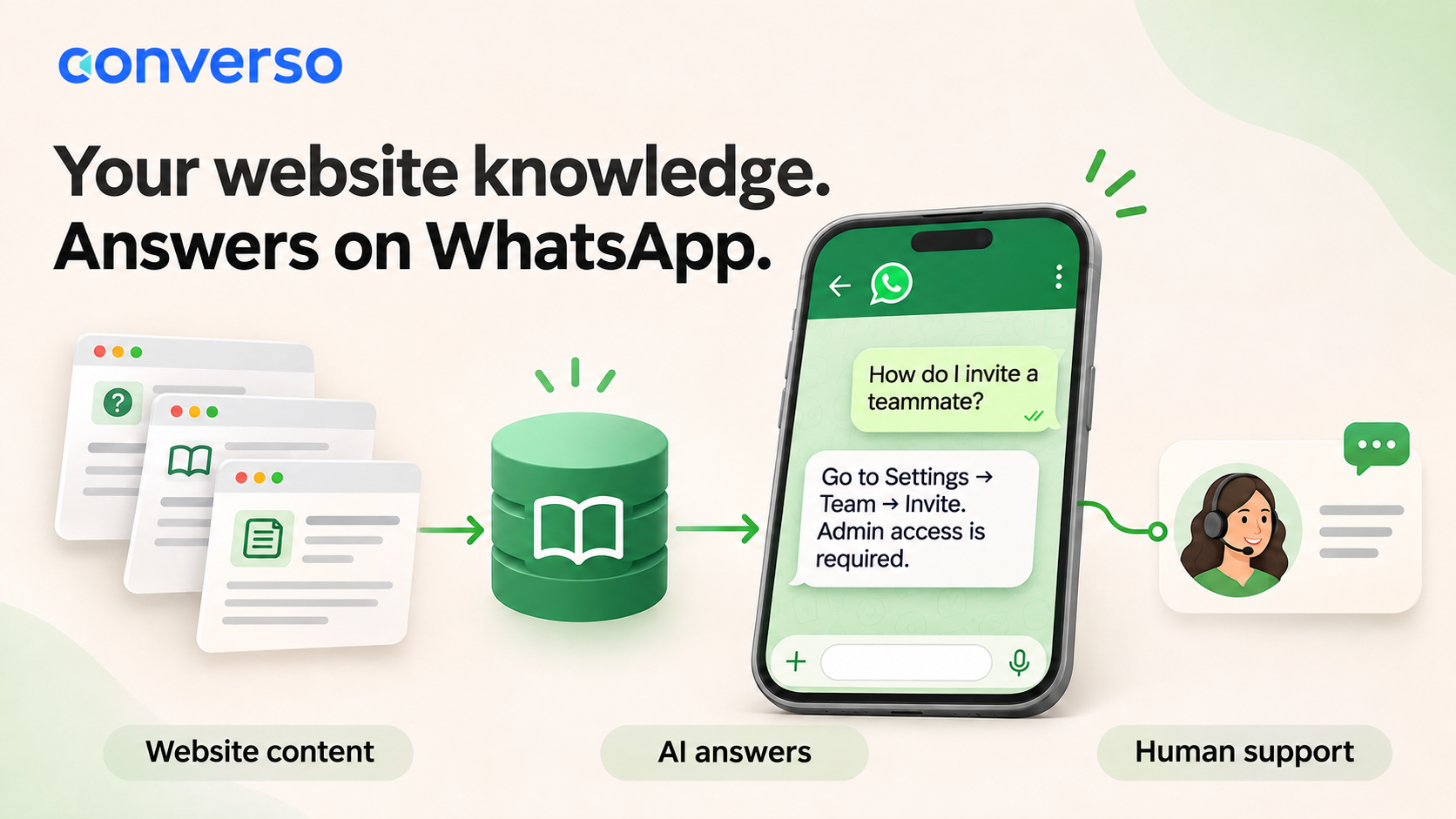
That's why we at Converso are building Exchange: it gives a business a channel for its buyers' PAs to ask a question, get an answer from a business agent, and turn each enquiry into a sales lead that can be followed up by the sales team, or their sales agent.
What to check on Monday
Ask an AI agent what your largest plan costs at ten times the volume, and watch where it stops.
Add "an AI agent" to your "how did you hear about us" field.
We'd love to hear from you about what happened when you tried, or what your own agent ran into when it went shopping.
Connect with us to help shape how PAs and the businesses they buy from talk to each other.
The ten companies
"Published" means the PA found the answer on the company's own site. "Needed a person" means the answer sat behind a form, a booking, an email, an NDA or a request gate.
| Company | What it does | Route to sales | Price at 10x | SLA | SOC 2 report |
|---|---|---|---|---|---|
| Tigris | Object storage | Needed a person | Published | Needed a person | |
| Tavily | Web search API for AI agents | Form | Needed a person | Needed a person | Needed a person |
| DataForSEO | SEO data API | Form | Needed a person | Needed a person | Needed a person |
| Mem0 | Memory layer for AI agents | Booked call | Needed a person | Needed a person | Needed a person |
| Exa | Web search API for AI agents | Form | Needed a person | Needed a person | Needed a person |
| Qdrant | Vector database | Form | Needed a person | Published | Needed a person |
| E2B | Code sandboxes for AI agents | Booked call | Needed a person | Needed a person | Needed a person |
| Browserbase | Browser infrastructure for AI agents | Form | Needed a person | Needed a person | Needed a person |
| Kagi | Search engine | Needed a person | Needed a person | Needed a person | |
| Financial Datasets | Financial data API | Form | Needed a person | Needed a person | Published (audit in progress) |
Tested with Manus in October 2026. One agent, ten companies, one set of questions: a snapshot on PA buyer research.